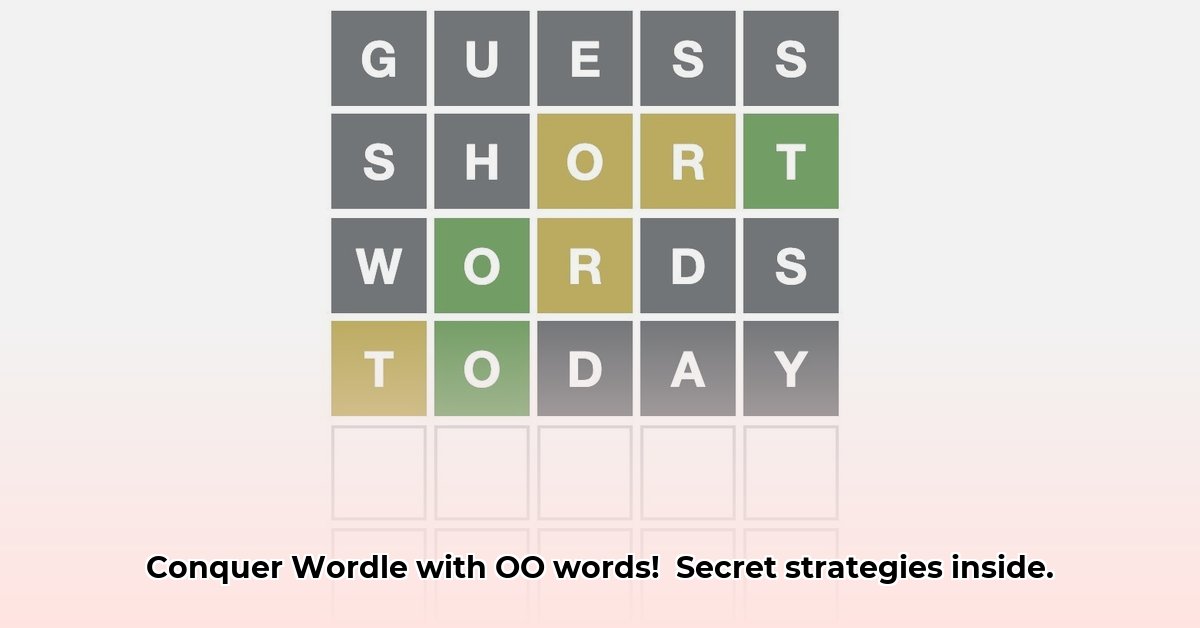
Improve Your Wordle Score with OO Words
Wordle. We all love it, we all struggle with it sometimes. But what if I told you there's a sneaky strategy that could seriously up your game? It's all about using words with double "O"s. Sounds simple, right? But trust me, it's a game-changer. This isn't just about luck; it's about smart play. Let's dive in and unlock the power of "OO." For more "OO" word options, check out this helpful resource: Words Starting with OO.
Why Double "O"s Are Your Secret Weapon
Think about your typical Wordle strategy. You probably focus on common letters, right? Consonants like 'R,' 'S,' 'T,' 'L,' and 'N,' and vowels like 'E' and 'A'. But what if you could cleverly eliminate a huge chunk of possibilities really fast? That's the magic of "OO" words. They're surprisingly effective at narrowing down the options, giving you a significant advantage. Many Wordle solutions actually contain double "O"s, meaning this strategy can get you to the solution quickly, or at least closer. It’s like having an extra clue right from the start. Don't you want to improve your Wordle first guess accuracy? Using an "OO" word in your first guess greatly increases your chances.
Choosing the Right "OO" Word: Your Arsenal of Attack
Picking the perfect "OO" word isn't about just finding any word with double "O"s. It's about strategy. You want a word that offers a good mix of commonly used letters, including other vowels, to maximize your chances in each guess. Let's look at some solid options and why they work:
| Word | Why It's Great |
|---|---|
| FLOOD | It packs in 'L' and 'D,' which are commonly used letters, along with the vowel 'U'. |
| BOOMS | 'M' and 'S' are frequent letters, and the vowel placement is helpful. |
| POOCH | 'P' and 'C' add to the variety of letters; 'P' is a frequently occurring consonant. |
| FOOLS | Includes 'F', offering more diversity in your letter selection. |
| MOON | A simple, yet solid starting point. Great for testing vowel placement. |
| ROOM | Another excellent choice for checking vowel positions right away. |
| BLOOM | Offers a balance of common letters and vowels. |
| SHOOK | A bit rarer but can be effective if your first few tries didn't work out so well. |
Remember, your word choice should adapt to what you've learned from previous guesses. The aim is not just to find an "OO" word, but the most informative "OO" word.
Advanced Tactics: Going Beyond the Double "O"
While "OO" words are fantastic, they are even better when combined with other effective Wordle methods. Consider these tips:
Maximize Your Letter Coverage: Your goal is to use as many common letters as possible in each word selection. Don't just focus on "OO," but spread out your guesses to cover a wide range of common letters. That way each guess gives you a wealth of information, making each guess more efficient. This is important to minimize the number of attempts.
Master the Color Clues: The colored squares after each try - green, yellow, and gray - are your best friends. Use them! A green square means that letter is correct and in the right spot. Yellow indicates the letter is in the word, but not in that spot. Gray means the letter is not in the solution at all. This information is completely crucial to guide your next choice of word. Use data from earlier guesses to make more targeted selections in the next round.
Become a Pattern Detective: As you play more Wordle, you'll start to notice patterns. Certain letter combinations appear more frequently than others. Use this information to inform your guesses. Your experience will start to help guide your choice of words.
Let's Play: Step-by-Step Examples
Let's walk through some scenarios to see how effective "OO" words can be in practice.
Scenario 1: The "FOOLS" Start
You start with "FOOLS." Maybe you get a yellow 'O' and a green 'L'. That's great! This means 'O' is in the word, but not in the third position, and 'L' is correctly placed. You’ve significantly narrowed down your options. Your next move might be a word like "BOOMS" or "ROOM," depending on what other clues you've obtained.
Scenario 2: Starting with "MOON"
Let's say you begin with "MOON" and get a gray 'M', a yellow 'O', and a yellow 'N'. This tells you that 'M' isn't in the word at all, while 'O' and 'N' are present, but misplaced. "POOCH" might be a smart next choice. It already uses 'O' and tests the placement and includes a few high-frequency consonants.
Track Your Progress: Become a Wordle Strategist
Wordle mastery isn't about random guessing; it's about learning and adapting. Keep a record of your games. Which "OO" words worked best for you under which circumstances? Which ones consistently failed? This data is your secret weapon to crafting a winning strategy. This is a personal process, so you have to discover what works best for you. By consistently applying these strategies, you’ll greatly improve your Wordle success rate. Happy puzzling!